 RSS feed
Today is Melbourne Cup day in Australia, one day a year when the entire nation stops for several hours in the afternoon, to drink champaign and sit back and watch 24 almost grown men, whip 24 poor horses around a 3.2 kilometre track. Perhaps appropriately sponsored by Emirates, and proudly promoting gambling in Australia. Have we come nowhere in 200 years?
There’s a revolution going on in the music industry, and the industry hasn’t noticed. With all the brouhaha about p2p, DRM, piracy and copyright, the RIAA and its members, the big record companies, have clearly taken their eyes off the ball.
I was at a gig for The Bronx last week (whose web site unfortunately doesn’t support Safari), a hardcore band from Los Angeles, and on the way out, amongst their t-shirts and CDs for sale, was a DVD of one of their live gigs.
But this wasn’t your regular live DVD, it was a recording of their first Sydney gig earlier in the year, which also happened to be their first ever sold out headline gig. The recording was made by a fan on a handheld DV, and the quality was good enough to publish. The day after that gig, the fan contacted the band and they arranged for the footage to be released as a DVD. Coincidentally, at the same gig, a local company has been recording and broadcasting shows over the Internet, and they just happened to have a mixing desk recording of the gig, which was then dubbed over the footage. No edits, just video from the handheld, and audio from the Internet broadcast. Now this isn’t a big production venue. The Annandale Hotel is a fairly small few hundred people at most venue. And The Bronx aren’t particularly well known, except that they did get album of the week at some point last year on 2JJJ.
I was at that same venue on the weekend, to see a one off (well, twice off, they did the once off thing last year) reunion of another punk band, this time a local Sydney band from the early 1980s, The Kelpies. At the gig, they were selling a copy of the one off gig they did last year, on CD, and this night they were recording a DVD of their last ever gig. It didn’t help that their bass played died last week just before the show, but the added risk of getting in another bass player from the same punk period to learn all their songs, makes it an even more unique DVD. They were collecting email addresses on the night, so they could let people know in a few weeks when the DVD would be available.
About a month ago, I went and saw DKT/MC5, a reunion of the three still alive members of the MC5, a detroit band from the early 1970s, who were the primary influence on pretty much most punk and alternative bands in some way. They played the Gaelic Club and the Coogee Bay Hotel, which is the old Selinas venue. Pretty big, but that doesn’t count. Ten minutes after the show finished, they’d pressed copies of it on to CD to buy on the way out. At Selinas, after ten minutes you’d be lucky if 20% of the 1300 person audience had gotten out. To then see a $10 CD of the gig as you went out the door, is pure marketing genius. We’ve read about this happening in the U.S., but this is apparently only the second time it has been done in Australia, the first being when The Who played in Sydney the week before.
On top of this, in the U.S. there’s a company called eMusicLive, which sells keychain USB drives of gigs on the way out. They also then sell the recordings over the internet, but you get the point. Same trick, newer technology.
And at yet another gig over the weekend, a local support band was selling their own independently recorded and produced CD at their gig for $15. I wouldn’t pay the usual $28 at a store, but for $15, while my body was still warm, sure, I’ll buy that. This has been happening for years of course, bands selling their independent CDs at gigs, and even that hasn’t begun to click with the record industry.
Artists are finding ways to change the business model, look after their own interests, and look after their fans. But then artists have always tried to do that, it is just the record companies that treat the fans with contempt, or as is common these days, just sue them.
As predicted several years ago, the space is changing, artists are finding ways to look after themselves, and make money off merchandising, without being tied to a major record label. And when USB drives and RAM devices become more prevalent, we’ll finally see the end of the CD as well, which artists are still paying royalties to Sony and Philips on, for every CD they manufacture.
There’s a revolution happening, and the industry, bless their little capitalist monopolistic hearts, have been caught well and truly napping. Good riddance I say. After a 50 year break, it is time to return art to the artists.
I hate email. I’ve been (ab)using it since 1984, and it still doesn’t communicate the way I do. In fact, the last few days, I’ve had two communication breakdowns involving email.
The first was an email from an acquaintance asking for feedback on a project proposal. So I sent them my feedback. The problem was that I sent way too much detail, because unknown to them, it was an area in which I tend to specialise, user interaction/interface design. This then made me look like a bit of a smart arse and a trouble maker. Imagine asking an NRMA safety officer which bull bar to buy for your 4WD, or asking the tax office which loop hole you should be using this year.
There’s a decision to be made here about whether to give them the full detail, which is ultimately the best way to help them out, or on the other hand to give them just a smattering of feedback, enough to make me look helpful, yet not enough to show that I know very much about the subject.
I could of course ask them how much feedback they want, but then I’ve already started down the slippery slope of being a smart arse.
Which bull bar should I buy for my 4WD?
How much detail would you like?
The second breakdown was one of those split email threads, where an initial email splits into two completely different arguments, multiplexed over a single thread. In most cases, the thread becomes two people trying to explain that what they said, wasn’t actually what they said, and it escalates from there, with each person concentrating more and more on the actual words, not the meaning of each email, and the two perceived arguments getting further and further apart.
But you had a comma between them, which means you don’t agree, else you should have used a semicolon, especially when followed by a verb. No wonder you misunderstood me! And anyway, who said I was being pedantic, I was just pointing out the inconsistency of your logic when used to arbitrarily compare two different technically correct yet contextually incorrect statements.
There’s a decision to be made here as well, at which point to pick up the phone, or if you can’t, at which point to resign from the thread, knowing full well that the other person will think that they’ve won an argument, even though it never existed. Ahh, the human condition, never wanting to lose, especially when there’s nothing to lose, but the winner perceives that there is. 🙂
Both of these communication breakdowns probably wouldn’t have occurred if we were talking to each other in person, or even on the phone. The risk of argument is higher, because you’re in a live conversation, with limited opportunity to think about what to say, yet communication tends
to be more successful. With email, you have a lot of time to sculpt the perfect reply, which in most cases is then completely misunderstood.
This is why I believe anyone can play improv. We do it everyday when we communicate with people, reading visual and audible cues, planning our responses, navigating our way through the miscommunication minefield.
Improv isn’t about learning to improvise, it is about removing the boundaries which growing up has placed around our natural ingrained ability to improvise. The world gives us our inputs, and we adapt or improvise accordingly. That’s life. Breaking these boundaries can be difficult for some, but is always possible.
Sensis is an Australian search engine company. They’ve only recently come on the scene, with what seems like pretty big advertising budgets. They’re actually owned by Telstra, our half government owned telecom company, who have been trying to work out how to make money out of their stock pile of underground copper wires, and who have spent much of the last decade trying (and failing) to understand what leading edge technologies they should be investing in. Not unsurprisingly, in 2004 they’ve decided in a moment of dumb arse brilliance, that a search engine might be a good new technology to spend our tax dollars on.
Anyway, I had a referer this evening from a Sensis search come into my RSS feed as if it were a web page. Dumb. Just plain dumb.
Want some more dumb? Here’s a quick 5 minute review of their results page:
- there’s no hyperlink on result URLs
- there’s a text input field labelled “In this location:”, which makes no sense until you click on “Australia only” and find out is some free form text location field
- the aligned “Australian sites only” radio control gives the impression that it affects the location box. check the radio and enter “london” into the location field. who knows what happens, as the controls don’t reinforce or support each other
- “worldwide sites” radio control isn’t aligned to indicate it’s affiliation with “Australian sites only”, or anything really
- the sensis logo takes you to the main entry page, which apparently has this URL: http://www.sensis.com.au/siteEntry.do;jsessionid=3gbwt2ri5pmbf.server2-1. why not www.sensis.com.au? they can’t use www.sensis.com, because there’s already a U.S. based defence company called that, which makes you wonder how they decided upon the name
- there’s a strange blue curved arrow in front of search result text. i’m guessing it means “abstract”, but there’s no alt/title text, and it is bright enough to indicate that it serves some more significant purpose. oh there we go, a legend which means it is “web only”. huh?
- the “Search within your results [SEARCH]” is confusing all on one line, and doesn’t clearly indicate that this is a search refinement
- the site uses greys and other pastel colours, making it harder for people to do what they’re ultimately at the site to do: find information quickly
I was reminded over the weekend why I love developing software for Apple products, and that I haven’t done nearly enough of it recently. Having spent almost 25 years of my life developing for the Apple II, and the odd thing here and there for the Mac, I thought I should take a look at Apple’s latest Xcode IDE for OS X. Nice. 🙂 (By the way, OS X is pronounced “oh ess ten”)
I’ll probably blog about it later, but I decided to build a virtual radio broadcasting mixer, after being disappointed at what I found on the Internet when I went looking.
Anyway, Xcode is Apple’s current development environment, which includes a funky app called Interface Builder. Interface Builder lets you build all your UI, as you would in any modern IDE, but includes a few extra cool features.
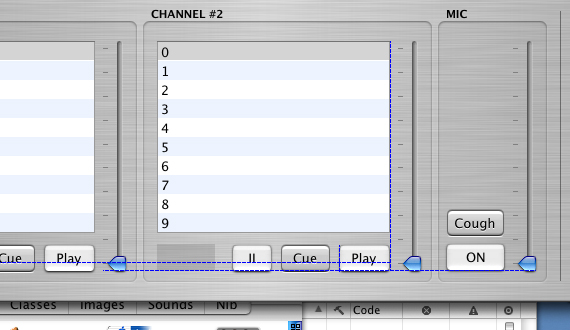 OS X is built around Objective-C and the MVC design pattern, and the name Interface Builder comes from the fact that you use it to visually model your MVC including Objective-C outlets and actions.
When you start lining up controls for a window in Interface Builder, instead of fixed grid sizes like in most IDEs, it generates dynamic grids based on the Apple Human Interface Guidelines. For example, “push button” controls can be 20, 17 or 15 pixels in height, but must be 12, 10 or 8 pixels vertically and horizontally spaced respectively. Certain reserved buttons, like Cancel and OK, must be 68 pixels wide. Lining these controls up in the old days consisted of either manually plugging in values (before we had visual resource editors), or lining them up on dodgey fixed grids that took no notice of controls widths, heights and embellishments.
Well, when you drag controls around in Interface Builder, a dynamic grid is displayed, with line guides wherever an appropriate grid snap should be. In the screen shot, you can see guides for the button text baseline, the bottom button align, the minimum horizontal button spacing, and the right align with the list control. Move the target button around, and guides appear or disappear as appropriate, and the control will snap to a guide when within about two pixels of it. Considering that all OS X controls have an inner frame which is the alignment border, and an outer variable size embellishment frame for the 3D and shadowing effects, this is a life saver.
More on the mixer later, but no wonder there’s a lot of software coming out for OS X. The tools are great, and Objective-C with Interface Builder and other tools is a breeze to use.
Jason Scott is putting the finishing touches on his BBS Documentary, covering the history of the BBS scene from 1978 to the present day, or at least when the web sort of took over from the BBS.
Released on 3 DVDs, with 200 interviews and taking 3 three years to produce, looks like Jason’s done an amazing job, especially getting hold of a lot of the original innovators like Ward Christensen.
Although I haven’t actually seen it myself, I’m sensing a big hole in the research with respect to the AppleII, and more specifically Australia, which had a huge BBS scene. However this is our problem, not Jason’s, as we never really found the time to answer his questions or document the local history for him. Seems a shame to do it after the documentary’s come out, but he’s pestered us enough over the past few years, or least I’m guessing that Andrew was as well.
The only mention I did get is for Eclipse (yes, we had the name first), a pretty cool project, but not much of a landmark release for Australia. In fact I don’t think anyone ever ran it locally, as by then the whole scene had pretty much collapsed. And to rub it in, Andrew gets top billing, which I guess is probably fair considering he basically took over the project once I’d gotten over it. Eclipse was a development platform, including plug in drivers and a Pascal/REXX hybrid language designed specifically for BBS use.
Anyway, if you have an interest in the 1980s BBS scene, take a look at Jason’s site, or even grab a copy of the documentary. And if you’re interested in hearing about the Australian history, then perhaps keep pestering me to find the time to write it all up. Although some of it is covered in my personal history of the Australian Apple II scene.
It’s been a week since I wrote about how podcasting will have its biggest effect on community radio, and about 3-4 weeks since podcasting began, at least in its current form. What we in Australia call community radio by the way, in the U.S. they call public radio.
Public/community radio is mainly funded by sponsors and government grants, this is true in Australia and the U.S., so to embrace podcasting, where is the money going to come from for the bandwidth and storage of program content?
Let’s actually drop the facade and instead of calling it podcasting, call it what it is, on-demand radio, which has been around for at least decade. The podcasting part is just the technology to get it out of a feed and onto an iPod or similar device.
Interestingly enough, the blogosphere seems divided at the moment between whether it’s a fad, or a revolution, although with a majority tending to side with revolution. Here’s one against, which pretty much sums up my opinion as well. Online Journalism Review has some good coverage of some of the issues, but at the end again descends into hypeland by quoting Russell Beattie slightly out of context. The ghist of it being:
[..] there are going to be 650 million phones shipped this year alone. How big will podcasting be when all those phones can be “podcast players?” Think you’re at the beginning of a trend now? Just wait.
Well like I said in my previous post, radio does this already. Everyone has a radio receiver, heck even my mobile phone does. How often do I or you listen to it?
The big problem is going to be content, and this is where the current community radio broadcasters will hopefully jump in, as that’s their biggest asset, varied programming. Unless of course they’re one of the stations who have already shifted from specialist to block programming. Wise move guys. 😉
Maybe Dave Pollard’s ideas will help, maybe more content sources will help, but in a world of information overload, when we’re bombarded left right and centre with information, including hundreds or thousands of RSS feeds, how many of us will bother listening to the radio for this type of content? I’m guessing roughly the same as do now. Except of course the podcasters, who don’t seem to have heard of or listened to community or public radio.
As an aside, in the next few months we’ll be trialling limited podcasting from our radio station. This in conjunction with our company’s work on Sauce Reader, should give us some valuable insight into where we’ll be in a few years’ time.
Saw a mildly amusing tshirt this morning on the way to work in Sunny ol’ Canberra, which I’ve since found after googling it, did the rounds a few years back. No matter:
There are 10 types of people in this world. Those that understand binary, and those that don’t.
Like I said, mildly amusing, perhaps because I fall into the former camp, and am still able to quote ASCII and 6502 instruction codes at will.
I was listening to 2JJJ last night, our government run national youth network (yes, I still refuse to call it Triple J, due to Barry Chapman‘s sellout), and heard yet another example of how we’re breeding a generation of youth ignoramuses who believe all the record company and branding/youth of today hype.
Anyway, I was listening ever so briefly (I promise) to Super Request with Rosie Beaton, who surprisingly knows a little bit about music pre-1991 (my era), and she was speaking with her producer on air, about tracks that various callers had asked for, particularly on the theme of treadmills.
Now the producer is the one who supposedly looks for each track and makes sure its the correct one, and I’m assuming knowledge of music to some degree would be one of the prerequisites. It was at this point she said:
And several listeners mentioned “Troo-ga-nine-knee” (laughs) or something (laughs) by Midnight Oil.
She’d certainly know Midnight Oil, all Australians do, and you may not expect her to know that Truganini is a song by Midnight Oil, but you would assume, being the lefty and informed station that it is supposed to be, that she would actually know who Truganini was.
Or do you think I’m being over judgemental because I still have a gaping wound about 2JJJ from 14 years ago?
A week or so ago, I wrote about Podcasting: The little brother of RSS, or the future of community radio? on my personal weblog, namely due to my background in community radio. Enjoy.