 RSS feed
I promise this is the last post about our recently elected right wing fascist government, and as with all final posts, I’ll go out with bang.
You know, today wasn’t too bad, the world doesn’t seem to have changed too much overnight, and I don’t think I’m feeling the breath of John Howard on my collar just yet. Although I do feel very tired, perhaps a lack of oxygen being produced by the few remaining trees in the country.
The one strange thing however, is that I’ve only been able to find one person (perhaps two) out of about 200 who actually voted Liberal. I was at a school reunion over the weekend, in the middle of the Sydney Liberal heartland, and it was seriously like a wake. Out of 106 attendees, across different classes, beliefs and mortgage states, nobody would own up to voting for the government.
Then on Sunday night, I was at a show, and again, of the 20 or so people I spoke to, not one thought the weekend was a particularly good one for Australia. Sure, in this case I’m talking about an arts crowd, but still, you’d expect to find at least one racist gun toting environment destroying economist, surely?
I’m tempted to launch a nationwide contest or reality TV show, like Australian Idol, in search of the people who voted Liberal. Rumoured to be extinct, we scoured the country, looking for Liberal voters who were willing to come out in daylight, and admit to their beliefs. The winner, the last Liberal voter left standing, gets to record their own policy, and join the rest of Australia’s politicians in the biggest reality TV show of all, the House of Representatives.
The other thing that’s annoyed me the last few days, is the number of people saying that they knew the government would get back in, including Labor voters. These are the same people who knew who would win Big Brother and Australian Idol. If I was so sure who was going to win, I’d have won a fortune betting on it already. And anyway, it makes you wonder why we even bothered, if there’s so many people who can see into the fucking future. I’m probably just frustrated because if John Howard had lost, I’d be saying the same thing. “Oh duh, it was obvious he was gonna lose!”
And on that note, my blogging shall now return to regular programming. I’ll speak to you again in another 3-4 years.
I guess this is where I insert the mandatory rant about how disgusted I am with the Australian public for voting back in a divisive blinkered short sighted lying right wing snivelling little turd who has run this country into the ground, and whose primary goal in life is to turn our amazingly beautiful island home into a right wing christian fundamentalist mini-America, extruded from G.W.’s saliva ridden butt hole.
But no, I won’t do that, as there is good news. At least we have a budget surplus, and so much cash in reserve that we can throw it around for in-tunnel filtration units and forestry compensation to keep the swinging voters happy. Because seriously, the economy is oh so much more important than people.
We wish our U.S. friends better luck than us, on 2nd November. Our hearts and minds are with you.
Well, after the local Liberal party put up signs about funding tunnel filtration, pretending to be local community group protest notices, the following morning they magically disappeared again. Perhaps the Lane Cove Sticker Syndicate Inc. Pty Ltd. didn’t like someone vandalising their property…
Podcasting in its simplest form, is the posting of blog posts in audio format, and having them automatically end up on subscribers’ iPods, ready for playback. It’s not so much the audio blogging that’s the innovative part, as on-demand audio has been around almost as long as the web. We used to broadcast our radio show on the Internet, back in 1998, and I’ve still got copies of shows sitting in my iTunes. Big deal.
The real innovation is making on-demand audio easier to use, namely through two technological breakthroughs: 1) automatically removing the audio from an RSS feed (via enclosures), and 2) automagically downloading the audio from iTunes specifically to an iPod, ready to play. Podcasting offers nothing new content wise that community radio hasn’t been providing for the last 40 years, but hey, everything goes in cycles.
The beauty of RSS/Atom, is that it delivers only the bare content, the raw information you’re interested in. You don’t have to visit a web site, you don’t have to scan through pages of navigation and HTML embelishments to get to the actual content.
Podcasting is supposedly the audio version of this, but it fails. All the podcasts I’ve listened to, including Adam Curry’s genre defining Daily Source Code, are about 20-30% useful information, and the rest is umms, ahhs, repetitions, or information that’s easier and faster to get in textual format through other feeds. In fact, all the podcasts I’ve heard, sound like they were simply recorded from community radio, and if you had to read that amount of text to get to the useful bits in a standard RSS feed, you’d end up unsubscribing.
Dave Pollard has talked about useful ways to reduce the effluvium in audio through the use of pitch shifting/time compression, which is infinitely more useful in reproducing audio with the useful characteristics of RSS content, than podcasting. But of course, useless content (umms, ahhs, repetitions etc.), at any speed, is still useless content.
There are however notable reasons why podcating will make a big impact, and it isn’t because people can get on-demand audio.
Lets talk about traditional radio for a bit. Webcasting was supposed to be the traditional radio network killer, and was going to eat into the major radio market over the years during and following the bubble. Like most ideas from that time however, the technologists failed to recognise what was so good about radio. Radio is audio only, there’s no visuals, plus most radio broadcasting is programmed for the masses, so it tends to be the conservative middle of what we as individuals would like to hear. We don’t get to pick the music that’s played, we can’t rewind at all, we have to listen at the exact time the show is on, we can only pick up certain shows in our local area (unless networked) and in many cases we don’t agree with the announcers’ opinions.
With all these flaws, how come radio still succeeds? For three reasons: 1. Because you can pick it up anywhere. 2. Because it is free of charge (no collection/bandwidth/CPU costs). 3. Because you don’t have to concentrate to listen to it, it runs in the background while you multitask.
At home, in the kitchen, while vacuuming, in the car, on the street, think of the radio walkman, or your clock radio which not only turns the radio on at a set time, but can also turn it off after an hour of you being asleep. On a plane, a train, in class, at work, radio is available everywhere, that’s why we tolerate all it’s inherent faults.
So what do the technologists do? They broadcast it over the web, thus solving the problem of reach, but breaking radio’s only real redeeming feature, the ability to take it anywhere. No wonder it failed.
But who says that reach was a problem anyway? Most local programming is local for a reason, meaning the only radio programming that really benefits from streaming is niche special interest programming. But the cache 22, is that with so few listeners, the chances are that most won’t be able to listen in at the right time anyway. Of course there’s always going to be a minority of people who want to sit at their computer all day and listen to low quality audio streams from Internet radio stations, but in general, webcasting is flawed for use in radio broadcasting.
So, the only real Internet based alternative to traditional radio broadcasting, is specialist programming. There are still problems of course, people can only pick it up while they have an Internet connection and a capable computer, tuning in is harder than using a radio, and not everyone wants to sit in front of their computer just to hear the radio. By providing the content on-demand however, people can listen to what they’re interested in, in their own time, and this is the principle behind podcasting.
The bottom line is, the only type of radio broadcast that will be better served with podcasting, is actually community radio. This is why podcasting is so important, because it will change the community and special interest radio stations forever, and will probably shut a lot of them down. Podcasting is community radio.
There’s an argument doing the rounds of the blogosphere at the moment that podcasting will threaten the big radio broadcasting networks, but for the reasons above, that’s not going to happen.
First, mainstream radio only works when everyone can pick it up anywhere, and the only real solution to that is a big mast, real estate to house it, an expensive and power hungry transmitter, and an expensive license from the government regulator. This won’t change, because the radio wave spectrum is becoming more and more expensive as technology advances.
Second, community radio has been around for almost 40 years now, and hasn’t affected the big networks one iota, even though, like podcasting, like webcasting, it was supposed to. What’s more, at the moment community radio is easier to pick up and listen to than the Internet, for the reasons mentioned earlier. Even my phone picks up radio and has earphones, that’s the sort of simplicity that you’d need to equal or beat.
So, podcasting won’t affect mainstream radio, but it just may replace community radio, and that’s a big shame. However, unlike the record companies and the RIAA, we’ll be working our butts off over the next few years to make sure our community radio business models change as the technology changes. Instead of fighting the podcast revolution, we’ll actively integrate it into whatever form community radio will take over the next 5-10 years. Watch this space, the world is about to change again, and not in the way most podcasters are expecting.
Don’t get me wrong, I like the Daily Source Code, and would love to have it on our radio station, but really, it’s still just community radio.
 Looks like The Lane Cover Sticker Syndicate Inc. Pty Ltd. is at it again. Here’s the sticker they left on our mailbox this week. A bit hard to see, because my camera phone’s not that good at macro shots, but you can see the amateurism and the white mark still left from the previous sticker. Bastards.
Amusingly enough, our local (coalition) member wrote to us this week, saying that if re-elected, he would contribute $10 million in federal money towards filtration of the tunnel. We’ve had signs all along our main roads for the last few years complaining about filtration, erected by the Sticker Syndicate, but this morning those signs changed to “Coalition gives $10 million to filtration, everyone else $0”. However if you got out of your car and walked up close to these signs and read the small print, you’d see that they’re actually Liberal party advertising posters posing as local community public service announcements. That’s slimey, and taking advantage of local residents. Not exactly what you’d expect from a local member, or maybe you would.
This is the same politically minded federal government who says they won’t fund hospitals because they’re a state budget issue, yet with an election looming, are suddenly able to fund a local state government filtration project. Nuts. I’d call that hypocrisy, but at least the money’s being offered.
 Shot this today at
Grace Bros Myer, while three wise , yet bored, salesmen looked on. Good to see Santa’s marketing types starting the season early. Nothing like good will to all men in spring (or fall/autumn, if you’re that way inclined).
You know it really makes you wonder what planet some people, particularly politicians, are on. This week the Australian Labor party announced that they would move towards protecting one of Australia’s great natural wonders, our old growth forests in Tasmania. No major party has ever taken this big environmental challenge, especially a party in opposition, going into an election, with the threat of forestry unions pulling out their support for your party. Yet they still had the confidence to do it. That’s a telling statistic!
The government’s best come back? “It’s just a dirty preferences deal!” Sure it is, but at least the forests will hopefully be protected. Talk about hypocrisy, that’s no different to the government sending us to Iraq on false pretences, then justifying it by saying that the dictator was bad and had to go anyway. Who cares why, so long as the benefits are realised.
In many ways, these U.S. and Australian elections are a reflection of the 21st century world in which we live. For the first time in history, the majority of people do care about protection of our natural environment, our flora and fauna, and equality for all people. And with two hopefully outgoing governments, this will be a turning point for the world, regardless of who you prefer to be in power. Kerry and Latham aren’t perfect, but they represent this definitive shift to more left wing policies and support for the lower and middle class.
This is the anti-plastic-bag generation, a generation of people who actually believe in the big supermarket scams (more on this conspiracy later) to move from plastic bags to reusable bags. A generation of people who at last believe that our flora and fauna need protecting, a generation who demand filtered and bottled water, instead of the natural water which falls from the sky. Yes folks, the world has changed, and we haven’t noticed.
The Tasmanian situation has been a political mine field for decades. You can’t protect the forests without pissing off the foresters, who are supposedly a majority large enough to swing the Tasmanian seats. But now we have a major party saying that the time has come to kiss forestry in old growth forests goodbye. Sure, it took a AUD$800M reskilling sweatner to top it off, but studies show that the forestry industry in Tasmania has been naturally declining for many years, and there is this myth that the Tasmanian electorates revolve around axe and chainsaw wielding voters, when in fact polls are showing that the majority of Tasmanians want the forests protected.
Even the official government tourist site for Tasmania, Discover Tasmania, says that their natural environment is pretty much their only attraction.
Yet the blinkered Tasmanian premier, Paul Lennon, doesn’t even understand his own state, and has come out supporting the forestry industry. Perhaps he does get it, but is faking it until the federal election fights his battle for him. Either way, he’s an ineffective patsy for industry. Paul Lennon didn’t get voted in, by the way, he got the job when the previous (and also pro-logging) premier died of cancer earlier this year.
When we see thousands of people marching against the government in the streets of our capital cities over the weekend, when the opposition party says that more money will be spent on hospitals and education (and the government doesn’t), and when they have the political confidence to stand up to the logging unions, surely this is a sign that something in this country, as well as in the U.S., is about change? Perhaps the gradual increase in media coverage has blinded us, but I have never seen so much protesting over our two governments, since at least the Vietnam war. And THAT is a telling statistic!
Our planet, and the conscience of our people has changed immeasurably over the past four years. We’ve seen the rise of anti-corporatism, anti-commercialism, and pro-conservation, the anti-plastic-bag revolution, and unfortunately (or fortunately, depending on how you look at it), our governments and politicians haven’t taken the slightest notice.
Yes, these U.S. and Australian elections will be a turning point for the future of our planet, and will reflect the ground swell we’ve seen over the last 5-10 years, for a philosophical change in the way governments look to and support their people. And it is about fucking time. Bring it on!
Recently I’ve been increasing the number of blog posts which talk about impro, not intentionally, but in response to the number of Google referals I’ve been getting recently now that Scared Scriptless (web site design still pending) is back up and running at the Clarence Hotel in Sydney. I’ve also been a bit shy about posting in public about it, why I’m not too sure, but an increasing number of players are telling me they bumped into my site, so I’m guessing it aint too bad, and it is safe to come out of hiding so to speak.
Anyway, today I had another one of those classic Theatresports degrees of separation moments. Last weekend I went to a non-impro wedding interstate, where I met a Science Communicator who was a nose bogey giving guided nostril tours at the Edinburgh Science Festival. Amusing, and a nice claim to fame, she outa do impro. Then another non-impro person mentioned a Science Communicator friend of theirs who was currently doing a Theatresports course. Nice coincidence, and I left it at that.
So tonight I’m at the show buying a drink at the bar, and this guy says he liked my gibberish endowments scene. A short exchange later and I find out he’s doing an impro course, and is a muso as well, and as we’re always looking for talented musos, he gives me his business card. Hmm… the first name sounds familiar. Bam! It’s the Science Communicator guy mentioned at the wedding, he knew about the wedding, knows where I used to work, and had already heard second hand the story about the nose bogey girl, yet didn’t know about me or who I was. No connection, but amazing coincidence.
Freaky coincidences like this seem to haunt my life, and at times it makes me question whether there’s more to it than just coincidence. But then I remember that so much of our lives is not coincidence, that perhaps the significant thing is that on average we should actually have more coincidences in life than we do. What a strange thing is existence and the human condition.
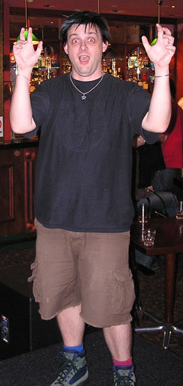 Apparently this photo of me after directing the Scriptless final a few weeks ago is funny. Yeah, amusing, but you should have seen what Rob and Amanda were doing!
I’ve noticed that my posts are quite verbose and vague at times, so I’m going try something new. Reduced verbage, more examples and less (maybe) soapboxing.
My post on CSS and dynamic page construction drew a comment about how I was an idiot for not using CSS. The problem is that I never said that we weren’t using CSS. CSS is a great technology, just not for certain types of web sites. You’d think I’d be able to explain my position a bit better, but it took Matt (our Sytadel technical lead) to come along and explain it a bit better by asking a few important questions. So let me try again.
Think of a web page, which contains the following:
This is emphasised.
Assume it contains some CSS selectors like the following:
P { font-family: Tahoma, Arial, Helvetica, sans-serif; font-size: 10pt }
EM { color: red; font-weight: 200 }
DIV.photo IMG { margin: 0.5em }
These selectors state that paragraphs will be in Tahoma, EM elements will be in red, and IMG descendants of DIVs with a class of “photo” will have a half em margin.
Now assume the above HTML fragment is placed inside a web site which has a completely different branding, yet we still want the HTML fragment to display as it would on the original site. Perhaps the new site is an aggregator for other sites, or a portal with previews of other sites.
We now have problems. How do we specify red EMs for the HTML fragment? The obvious solution is to wrap the fragment in a DIV with an ID or CLASS, and change the EM selector to a descendant selector:
EM { color: red; font-weight: 200 }DIV.fragment EM { color: red; font-weight: 200 }
This fixes the EM, but what about the other infinite number of combinations? Perhaps we just take the style sheet and prefix everything with the DIV.fragment descendant selector?
DIV.fragment P { font-family: Tahoma, Arial, Helvetica, sans-serif; font-size: 10pt }
DIV.fragment EM { color: red; font-weight: 200 }
DIV.fragment DIV.photo IMG { margin: 0.5em }
Unfortunately this doesn’t take into consideration the initial default CSS settings for all the standard HTML elements. For example, the original site uses the default for TH, a centred bold, yet the new site has its own definition, a left aligned pink. Now we need a DIV.fragment TH selector in the stylesheet, which resets every CSS attribute for TH, so it looks like the initial default state. Likewise, our fairly short P selector would now expand out to several dozen lines defining the default styles for a P element. I’m not even sure if that’s 100% possible to do, take an arbitrary CSS state and redefine it to the original initial default settings.
What if we wanted the new site to display the fragment slighty smaller inside a box on it’s pages? Simple, use a font-size: 0.8em on the fragment’s wrapping DIV:
DIV.fragment { font-size: 0.8em }
The problem with this though, is that the fragment already has a definition for a 10pt font size, so the new site has to know this, and remove it, along with any other definitions which conflict with it’s wishes. Then don’t forget to include all those CSS resetting definitions as well. Be careful of the ones that interact in mysterious ways, like how a TD can affect the style of a P, regardless of the cascade.
One last problem I’ll mention, and yes there are many others, is what if “photo” is also a defined class in the new site? So we now have to go through and rename all the classes, and update the stylesheet so there’s no conflict. At least this one seems easy enough to solve with some simple renaming logic.
All these problems go away of course, if the person coding the stylesheet knows what the final HTML will look like. This is the Zen Garden catch, you need to know what the code looks like, before you can start doing anything interesting. In some CMS environments, you don’t have that luxury, which limits what you’re able to safely do design wise.
Which brings me back to the original statement from my previous post which the anonymous comment poster took issue with: CSS is designed to be applied by designers who know exactly what is contained within the page. If you don’t know the CLASSes, the IDs or the hierarchy, then good luck applying any sort of design outside single element level embellishments, like site wide font size or background colour.
I think it is possible to design a layout and style technology which address these problems, and even amendments to the CSS standard could possibly get us most of the way there. But that’s best left for another post.
OK, so I lied about the soapboxing.
(Originally posted to Synop weblog)