 RSS feed
Still catching up on delayed blog posts due to last week’s disaster, but the big news this week is that the big red pop filter at our radio station has disappeared again, as quickly as it had appeared. Never more to invoke the muffled giggles of our many and varied announcers. You see, with many different cultures, classes and age groups on air, with all our differences, a knob joke in anyone’s language, is still a knob joke. Perhaps the powers that be prefer the old divide and conquer approach to community domination.
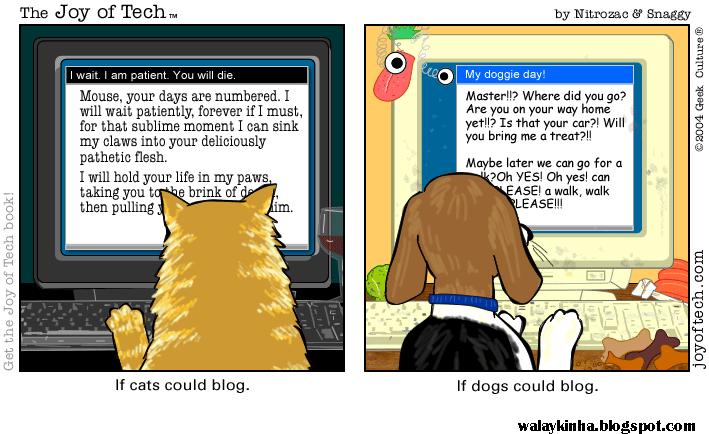
This is one of the reasons that I’m a cat person, and more significantly not a dog person. Celebrate individuality and the creative and adventurous spirit. Accept no substitute.
The “I found some of your life” post that did the rounds a few weeks ago was amusing. Not because of what happened, but because of what could be. Some background, a guy found a camera and didn’t know who it belonged to, so he posted one photo per day online and added his own candit comments about each photo. Eventually someone came forward and the site was taken down, but not before it did the rounds of the blogosphere, and finally made it to Slashdot, where someone put the pieces together and found other photos online of the same people.
Anyway, the interesting part is that this is effectively an old impro game we call Pop-up Storybook, where each scene is a frozen piece, improvised by on stage players, with an off stage player providing an improvised commentary. It is tempting to take a couple of dozen photos from a night out, and have some of Sydney’s top improvisers provide a running commentary online. There are sites for photoshopping contests, and photo caption contests, why not Pop-up Storybook?
Which brings up the issue of what other impro games could be played online?
Of course if you’re in Sydney, you could always see the real thing with yours truly, tomorrow night at the Clarence Hotel. 🙂
Sydney is tunnel mad at the moment. You can’t drive anywhere without bumping into a tunnel. Well, it isn’t that bad, but if you’re a politician trying to get ahead, slap a tunnel onto your platform and you’ll be in Canberra before you know it.
In our local area, there’s a big kerfuffle about a new tunnel they’re building, which will go pretty much under our suburb, and doesn’t include “in-tunnel filtration”. Here’s the official RTA page for the tunnel, and here are some activists for filtration, bicycle support and other bits and pieces, including a transcript of an ABC Stateline story covering the issue.
Anyway, the whole point of this post is that today I found a sticker stuck on my mailbox, which basically complained about filtration in the tunnel, and said that we as a community needed to do something about it.
I thought that in this modern age, that most people would have at least a basic understanding of psychology and the human psyche, and what it takes to mobilise and rally people behind a particular cause, or at least someone in such a group would. To then pick on my house, in a suburb that will not only not be adversely affected by the lack of filtration, but will actually have improved local traffic conditions due to the tunnel, and stick an ugly yellow permanent sticker on my mailbox saying such, is probably not the most ideal way to garner support for your activist group.
I tried scraping off the ugly yellow sticker, and the damn thing won’t come off. It left an even more ugly white square where the yellow used to be. Fuck filtration, I want the testicles of the streetwalker who vandalised my mailbox! After all, it could only have been a male.
So while we were going to start getting involved in the local community campaigning against the lack of filtration, we’re now reconsidering whether we really want to be involved with such muddle headed fools.
I’ve spoken a little about community groups in the past (Trust me, I’m not a psychologist and Community groups — a flawed operational model?), and the key thing, above all else, is identifying the skilled and passionate individuals, and empowering them with the authority and resources to enact the missions of the group.
A mistargeted campaign of sticker vandalism against your main prospect base I’d probably regard as a dumb arse backyard job, certainly by someone without the necessary skills or understanding, and whose knowledge of the issues is most likely flawed as well. Makes you question the activist sites mentioned above, doesn’t it?
Fortunately my green lefty socialist leanings mean I’ll still fight the issue, but I think you get my point.
Gee, what a week!
When you get to my age, it becomes increasingly rare to have one of those “most X in life” experiences. However, last week was probably the busiest week of my life, and trust me, I’ve had my fair amount of busy weeks in the past!
With not only significant day job project deadlines, but also six pretty big part time/hobby projects either due or beyond my delaying control, the week culminated with a pretty important on-stage appearance, for which sleep was going to be fairly critical. Even by the previous Monday, six days out, d-day minus 6 if you will, it was obvious that sleep deprivation, or deep sleprivation as I called it on d-day minus 1, was going to be the theme for the week.
Anyway, this means that blogging should perhaps increase again, sleep should improve, and I now have this sense of standing atop of summit, looking back down on the remains of projects and deadlines that were ticked off last week, and the ultimately not too impressive performance on the final day. This was all topped off by d-day plus 1 being a pretty important anniversary for me, which changes the perspective somewhat.
I’ll remember this week for a long time to come, for while to those around me it probably seemed fairly insignificant, it was indeed the busiest week of my life, when every waking moment was actually working on something that needed to be delivered to someone by a certain time.
When was your last “most X in life” experience? Perhaps that should be my mantra going forward, to have them more often than I have been of late.
Victor Lombardi’s article on integrating CSS with Content Management Systems (via Step Two Designs) provides an interesting use case for provision of CSS editing for CMS users. However in our experience, CSS just isn’t that abstracted enough from the content to be useful for anything but the most simplistic style changes.
In a moderately complex CMS, page construction is a dynamic process, meaning that layout tends to be quite generic, so the presentation may be used across multiple sections of the site. This can at times be a fairly limiting requirement, and actually conflicts with the precise nature of CSS, so much so that we’ve already resigned to the fact that CSS2 is a fairly flawed if not inappropriate technical solution for dynamic/generic presentation.
 Let us break down a dynamically constructed CMS page, in this case a page from one of our old company web sites. The diagram at right shows a page constructed by our Sytadel product, overlayed with colour coding for the main wire framed areas of the site. We refer to sections of content on a page as “boxes”, which is very similar to the flat CSS box model, but in Sytadel’s case, the boxes are hierarchical.
The key to dynamic page construction, is understanding the need for hierarchical page templates. In the example diagram, first we have a default site branding, which consists of the red header, the purple footer, and the left multi-coloured context box. Many technologists think a header and a footer solves the branding problem, but this doesn’t give your designers much flexibility. You typically need some type of high level template within which you can drop your page design and your generic content. In many cases this looks as if it is a simple header and footer, but underneath it isnt.
Once the branding is applied, the next level down is the main content layout, which in this example is the parent box for the blue, pink and orange boxes. Inside this is the blue content item box, containing what we call the primary item for the page, and the pink and orange item context boxes, presenting information appropriate for or related to the primary item.
Inside the left side context box, is another box which I’ve placed inside a solid red border. This is roughly at the fourth level down inside the page’s construction hierarchy, and contains various content creation, editing and maintenance tools.
This quite simple dynamic page, when modelled, has a fairly complex tree structure, and contains about 60 different views on various items from the CMS. There are full content views, like in the blue box, summary views of items, like in the orange and green boxes and at the bottom of the blue box, hyperlink views like in the red header, and even drop down control views in the light blue box.
I should add that with this type of construction, it is actually the primary item for the page which dictates the entire construction logic and ordering, not the page itself, and that the layout for each level needs to be defined in construction logic so that it may be reused, and not just through a standard CSS definition.
With all this genericism, how on earth do you apply CSS to layout and style? Well, Sytadel’s construction engine also builds inline ID and CLASS attributes for each box and each view of an item in a box. This way you can specify the style of a title of an item for example, when it is inside a hyperlink view, which is inside a content creation box, which is inside a left context box, which is inside a page layout box, which is inside a particular branding. Want to change how it looks to a particular user or group of users? Same idea, but just a little more complex.
This places a lot of the implementation upon CSS’ shoulders for layout and cascading, and unfortunately due to the still limited browser support for the more useful CSS2 features, and the flat-flow design of CSS, the design of these stylesheets can be fairly complex if you want them to be.
The initial design for Sytadel was of a complex generic and hierarchical page construction engine, where you can place views of items inside items ad infinitum. A great use for this is with thumbnailing of content. Mark a box with font-size: 0.6em and you suddenly have a way to thumbnail entire HTML items, and in Sytadel’s case we can even embed pages within pages, all CSS controlled through cascading.
CSS is designed to be applied by designers who know exactly what is contained within the page. Thus CSS styles are great for static sites, or for dynamic pages where most if not all pages have exactly the same layout or limited construction hierarchy. With dynamic sites however, CSS doesn’t really cut it, and certainly not for regular or even admin users to edit simple stylesheets.
Let’s be honest, changing the style of an H1 container isn’t really a particularly useful function for a CMS, and is probably more likely available for CMS expectance/compliance reasons than anything else.
Update: I’ve written a follow up to this post, The limits of CSS for dynamic page construction — explained, which goes into some more detail about why this is a problem.
(Originally posted to Synop weblog)
 The photo you see here is the new big red pop filter we have on the announcer microphone at our radio station. I bragged a bit about it the other night on the show, but for your own personal viewing pleasure, here it is in the flesh! So to speak…
The question I gotta ask though, is did the person who put it there know that pretty much every show for the next week is bound to do a whole bunch of knob jokes? Or did this simply slip from their mind while some enterprising young pop filter salesman had a giggle with his mates about the astronaut who bought the infamous red pop filter which had been sitting in their display cabinet for the last 5 years.
Anyway, while it makes you think to yourself for a few seconds every time you go back on air, at least it is more amusing than the standard regulation black. Could this be the beginning of the boom period for the pop filter manufacturing industry? Stay tuned folks, this could get nasty!
I don’t know why it happened, I don’t know how I found it, but the hyperlinks to some of my noise files were broken, and are now fixed. Enjoy. If you can.
Much of the brouhaha about bandwidth and scalability of RSS feeds stems from the common misconception that feed data is second class data. The Radio Userland model is just one source of the misconception, in that data is dropped into the queue, shuffles it’s way down the chain, and then disappears off the end, a window onto a moving data flow if you will. (Feel free to extend the chain metaphor to it’s logical conclusion)
If you continue this misconception, then you jump to all sorts of myopic conclusions, such as:
- Data is redundant – if you miss a post, who cares
- GUIDs are nice to haves – if I update an a post, who cares if the feed sends a second copy
- Full text isn’t important – just click and you’ll go to the item in a browser
- You’ll get the item eventually – who cares if it is a day late, so long as I can read it
- Filtering defeats simplicity – I’d rather have a million items to read through manually, than have a useful and usable mechanism for cutting, slicing, dicing and sorting important data
- Take what the site pushes – I like being subservant to big publishers, so I don’t have to think about what might be important to me
Wrong, wrong, wrong. Feed items are first class data, and should be treated as such.
When Scoble talks about pulling down full text for posted items, he’s not a nutter with shares in fat pipe providers, he’s an information consumer with a hunger for knowledge, and only he knows how and where he’ll use that data. Once I have that data in my possession, I can do with what I like, read it, re-publish it, annotate it, combine it, scan it, summarise it, print it (in my preferred format/style), convert it to spoken audio (using Windows and Mac voice tools), cross analyse relationships between items, etc. And once the data starts to move away from free text and into more structural data, the skies are the limit. I’m like Scoble (I can’t believe I just said that), and our numbers are growing.
Regardless of the filtering nirvana that I usually rant about, the future is coming, and it is full text and structural data, regularly updated on demand, navigable, and maintains data and relationship integrity. Sure, our current protocols are completely inadequate for these purposes, but then we’ve already been saying this to the RSS biggots for almost a year now.
I’m sensing momentum… perhaps the fog is starting to clear.
Not often, but every now and again I get a little guilty about my Google ranking for a particular query. At the moment I’m getting a lot of folks looking up The Clarence Hotel in Petersham, which is our new Sydney Scared Scriptless Theatresports venue. Unfortunately though, I don’t blog that much about it, even though I’m sort of directing or producing the show or something like that.
I mean we have a Scared Scriptless web site, which is unfortunately not really functional at the moment, but it will be up real soon now. Ryan?
But for news about the shows, people are still somehow finding their way to my blog, and certainly the first paragraph of this post isn’t going to change that too much. At least the title isn’t going to top things off.
The thing about Google, is that it is supposed to level the playing field, find the things you need, with the rankings you want, filter out those who are trying to stack things in their favor, and everyone’s happy. The problem of course is that most people don’t actually understand the mechanics and structure required of a good site to support Google and it’s peers, meaning that to keep a level playing field, I should really dumb down my site’s data quality.
But then who am I to complain if I get a higher ranking? If my Google referers are anything to go by, I should keep writing for my audience of people interested in Kristy Kreme (check the spelling), Oriental Lillies, How to win lotto and of course Scared Scriptless in Sydney.
The answer of course is for web site authors to do it right the first time, a good starting point being Gina Trapani’s Scribbling.net post on helping Googlebot to understand your site.